
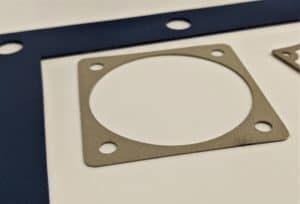
electrically conductive gasket
At NEDC, we cut a lot of interesting materials. One of the most commonly used gasketing materials are EMI/RFI Shielding Gaskets. They feature high levels of electrically conductivity imparted by their fillers, and low electrical impedance. Many of these gasket materials are certified to the MIL-DTL-83528. There are two main types of electrically conductive gaskets:
-Electrically Conductive Silicone Gaskets
-Electrically Conductive Fluorosilicone Gaskets
In this blog post, we discuss a few different types of electrically conductive silicone gaskets. Typically, EMI/RFI gaskets are used in enclosures, or connector gaskets(M83528/004XXXX). For silicone-based elastomers, the most commonly used connector gasket material for us is silver/aluminum in silicone(Type B)(M83528/XXXBXXX).
Electrically Conductive Tapes
When a customer orders an electrically conductive gasket, it will require an electrically conductive transfer tape such as 3M 9703, or 3M 9713. Of course, there are both acrylic and silicone transfer tapes available. Since NEDC is a 3M converter, we have access to all of the electrically conductive tapes offered by them. These different tapes aid in putting together components during assembly. NEDC can apply both silicone and acrylic based tapes to EMI/RFI shielding gasketing materials.
Conductive Silicone Gaskets vs ESD Gaskets
Electrically conductive silicone gaskets (per MIL-DTL-83528) fall in the conductive regime : typically below 10⁴ ohms per square : and are designed for full EMI/RFI shielding rather than electrostatic dissipation. The two regimes are often confused because both involve conductivity, but the applications are different: a conductive silicone gasket is used in a military connector or shielded enclosure where the goal is to reflect or absorb electromagnetic interference across a 10MHz to 10GHz+ range, while an ESD gasket is used in an electronics enclosure where the goal is to dissipate static charge slowly enough to protect sensitive components. For static-dissipation applications in the 10⁵ to 10¹¹ ohm/sq range, see ESD gaskets and pads : NEDC’s silicone and neoprene options are designed for that regime.
Compositions of Gaskets
| MIL-DTL-83528 Type | Filler Type | dB of shielding, planewave | Hardness Durometer Type A +/- 7 |
| B | Silver/Aluminum | 100dB @ 10GHz | 75A |
| M | Silver/Glass | 100dB @ 10GHz | 65A |
| A | Silver/Copper | 110dB @ 10GHz | 65A |
| E | Pure Silver | 110dB @ 10GHz | 65A |
| H | Pure Silver | 110dB @ 10GHz | 80A |
| K | Silver/Copper | 110dB @ 10GHz | 85A |
| J | Pure Silver | 80dB @ 10GHz | 45A |
| L | Silver/Nickel | 100dB @ 10GHz | 75A |
At NEDC, we manufacture a lot of custom gaskets. If you have an application that you believe could utilize an electrically conductive custom silicone gasket, or for more information please contact sales@nedc.com.