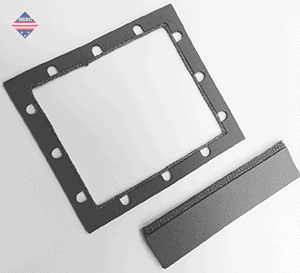
Gray Silicone Sponge Gaskets with Mesh Strip
The Elastomer
There are many types of elastomer available in combination gaskets, including silicone sponge, neoprene sponge, solid silicone, fluorosilicone and neoprene rubber. Applicable and respective specifications can be provided for these elastomers, such as ASTM D6576, ASTM D1056, A-A-59588, MIL-R-25988, and MIL-R-6855. These elastomers provide the weather sealing that is typically required in NEMA, and IP rated enclosures. Sponge materials offer more deflection with less force; conversely, solid rubber materials require higher compression for deflection in order to seal the mating surfaces. The sponge rubber materials can be especially advantageous in applications requiring lighter weight components. It should be noted that there are times when over-compression becomes a problem when bolting down a gasket. Over-compression can be prevented with something called compression stops.* NEDC oftentimes provides compression stops with its gaskets.
The Mesh
The second part of a combination gasket is the EMI/EMP shielding performance component. This part is normally provided through the metallic mesh. This mesh provides shielding through electrical continuity with its adjacent electrically conductive mating surfaces, while providing a durable, economic solution. There are a number of metals available, such as aluminum alloy 5056 per AMS-4182, Monel QQ-N-281 per AMS-4730, tin-plated, copper-clad steel per ASTM B-520 and others. There are number of geometric combination available with variations of mesh and elastomer cores and must be considered.
The PSA
A pressure sensitive adhesive can be provided on the back, or both sides of the gasket for ease of assembly. There are a few different types of adhesives that are typically available, including acrylic, and silicone. Oftentimes, acrylic is used because of its impressive cost to benefit ratio and its impressive weathering stability. However, a silicone PSA can be provided if required.
The formation of the gasket can be a challenge, but with the right fabricators these seals can be provided in an expedited and economic fashion.
Fabrication and Availability
NEDC is extremely familiar with fabricating gaskets for enclosures that have both a weather seal and a mesh strip (EMI/EMP shielding). When the two components are fabricated together, sometimes an RTV (room-temperature vulcanizing) agent is required. An RTV can make the gasket more economical to provide in contrast with other conventional methods. There are a number of configurations available for a combination gasket, for example fluorosilicone rubber with aluminum, or silicone rubber with a monel mesh strip. For more information on combination gaskets please contact sales@nedc.com.
*Compression stops are typically made of metal such as aluminum with chemical finishes like MIL-C-5541 1A.