
Laptop thermal pad selection is an engineering challenge that desktop cooling does not face. The combination of thin form factors, low mounting pressure, shared heatsinks, and flexible PCBs means that the pad material and thickness must be specified more carefully than in a desktop system.

This guide covers the engineering considerations for laptop thermal pad selection.
The Low-Pressure Problem
Desktop heatsinks are mounted with significant pressure — typically 40-80 PSI of contact pressure between the heatsink base and the CPU. This pressure compresses thermal pads and ensures good contact.
Laptop heatsinks operate at much lower pressure — often 10-25 PSI — because the mounting hardware is lighter, the chassis is thinner, and excessive pressure would warp the flexible PCB. This means the thermal pad must conform and fill gaps under less force.
Implication: laptop thermal pads must be softer (lower modulus, higher deflection) than desktop pads. A stiff pad that works in a desktop will not conform properly in a laptop, leaving air gaps.
For material recommendations, see our guide on soft gap pads (S-Class) and our ultra-soft thermal pad selection.
Thickness Precision in Thin Form Factors
In a desktop, a 0.1 mm thickness error is usually tolerable because the heatsink has enough pressure to compensate. In a laptop, a 0.1 mm error can be the difference between proper contact and a 1°C air gap.
Laptop thermal pad thickness must be specified to tighter tolerances:
- Standard tolerance: +/- 0.1 mm (acceptable for most laptops)
- Tight tolerance: +/- 0.05 mm (for ultra-thin designs where the gap is precisely controlled)
See our guide on tolerancing for thermal pads for achievable tolerances by material type. Reinforced materials (fiberglass-backed) hold tighter tolerances than unreinforced gap fillers.
Material Selection for Laptop Thermal Pads
Ultra-Low Modulus Gap Fillers
These materials are the best choice for laptop CPU thermal pads because they conform under the lowest mounting pressures:
- T-Global TG-A9000 — ultra-soft, high conformability
- Bergquist Gap Pad 2500S20 — ultra-conformable for low-pressure assemblies
- TFLEX HD300 — high deflection under minimal force
Phase-Change Materials
Phase-change pads are particularly well-suited for laptops because they eliminate the thickness-precision problem — the material flows at operating temperature to fill whatever gap exists, then resolidifies. This makes the exact pad thickness less critical than with solid pads.
Honeywell PTM7950 is available in 0.2 mm thickness, thin enough for most laptop applications. See our guide on phase-change thermal materials for more.
Silicone-Free Materials
Laptop interiors are densely packed with components, and silicone bleed from thermal pads can contaminate nearby connectors, webcams, or display flex cables. In these cases, silicone-free thermal pads are the safer choice:
- TFLEX SF10 — 10 W/mK silicone-free
- T-Global TG-APC93 — non-silicone
See our guide on why silicone-free pads are not exclusively used for a balanced perspective on when silicone-free is necessary.
Shared Heatsink Considerations
Most laptops use a single heat pipe assembly that cools the CPU, GPU, and sometimes VRMs. The thermal pads on each component must be the correct thickness so that the heatsink contacts all components simultaneously:
- If the CPU pad is too thick, the heatsink lifts off the GPU
- If the GPU pad is too thick, the heatsink lifts off the CPU
- VRM pads must be sized to bridge the gap without creating uneven pressure
This is why laptop thermal pad replacement requires measuring all gaps, not just the CPU gap. For more on this topic, see our guide on stacking thermal pads and why improper thickness causes contact problems.
Vibration and Shock Considerations
Laptops are mobile — they get carried, bumped, and dropped. Thermal pads in laptops must maintain contact under vibration and mild shock. Softer pads with inherent tack (or PSA backing) stay in place better than stiff pads that can shift.
See our guide on adhesive backing vs natural tack for PSA options.
Sourcing Laptop Thermal Pads
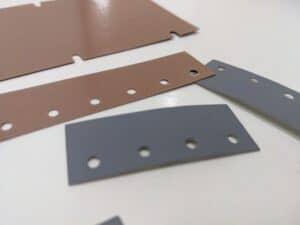
NEDC supplies ultra-soft gap fillers, phase-change materials, and silicone-free pads suitable for laptop thermal management. We can die-cut custom shapes for specific laptop models with tight thickness tolerances.
For prototype or small-quantity orders, our rapid prototyping service can produce parts quickly. For production, we offer die-cut parts with consistent tolerances.
Request a quote or visit our thermal pads page for available materials.