
The thermal pad vs thermal paste debate is one of the most common questions in CPU thermal management. Both transfer heat from the CPU to the heatsink, but they do so in fundamentally different ways. The right choice depends on the application — there is no universal winner.

This guide compares thermal pads and thermal paste specifically for CPU cooling, covering performance, installation, longevity, and use case recommendations.
Thermal Paste: How It Works
Thermal paste is a viscous compound applied between the CPU integrated heatspreader (IHS) and the cooler base. It fills microscopic surface irregularities — machining marks, flatness deviations, and scratches — that would otherwise trap air and impede heat transfer.
Advantages:
- Lowest thermal resistance when properly applied (typically 0.01-0.05°C·cm²/W)
- Conforms perfectly to any surface topology
- Widely available
Disadvantages:
- Application skill matters — too much or too little degrades performance
- No electrical isolation (most pastes are conductive or capacitive)
- Dries out over time, requiring reapplication every 2-3 years
- Messy to apply and remove, especially in production environments
- Pump-out effect on large CPUs — thermal cycling causes paste to migrate away from the center
Thermal Pads: How They Work
Thermal pads are pre-formed solid materials that compress slightly under heatsink pressure to fill gaps between the CPU and cooler. They are available in various thicknesses, conductivities, and material types.
Advantages:
- Consistent installation — same amount of material every time
- No curing or drying time
- Electrical isolation available (Sil-Pads)
- Long service life (3-5+ years) — no pump-out, no drying
- Easy to install in production and field repair
- No mess — pre-cut pads peel and place
Disadvantages:
- Higher thermal resistance than optimally applied paste (typically 0.1-0.5°C·cm²/W)
- Thickness is fixed — cannot adjust like paste
- Must select correct thickness for the application
- Higher per-unit cost than paste
When to Choose Thermal Paste for CPU
Thermal paste is the better choice when:
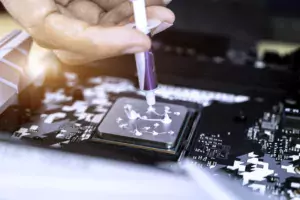
- Maximum thermal performance is critical — high-performance computing, HEDT CPUs where marginal thermal optimization matters
- The CPU IHS and cooler base are flat and smooth — paste fills only microscopic gaps, so surface quality matters
- The cooler uses direct-die contact — bare-die cooling (delidding, direct-die liquid cooling) benefits from paste’s superior conformability
- Cost is a primary concern — paste is cheaper per application than pads
For a general comparison of pads vs paste, see our thermal pad vs thermal paste guide and our older post on advantages of thermal pads over thermal paste.
When to Choose Thermal Pads for CPU
Thermal pads are the better choice when:
- Production assembly — consistent installation without skill-dependent paste application
- Electrical isolation is required — Sil-Pads prevent shorts between CPU and heatsink
- Long service intervals — pads do not dry out or pump out, making them ideal for hard-to-service systems
- Field repair — pre-cut pads are easier to apply than paste in non-lab environments
- Gap filling — if there is a deliberate gap between CPU and cooler, a pad bridges it; paste cannot
For more on using thermal pads for CPUs, see our guide on using thermal pads for CPUs.
Can Thermal Paste and Thermal Pads Be Used Together?
Generally, no — paste and pads should not be combined on the same interface. The paste prevents the pad from making direct contact with the surfaces, and the pad prevents the paste from spreading properly. Use one or the other.
However, on a single CPU installation, paste may be used on the CPU core with pads on the VRMs and VRAM — these are separate thermal interfaces, not the same one. See our guide on thermal pad vs thermal grease and mica for more on multi-interface cooling.
Phase-Change Pads: The Middle Ground
Phase-change thermal pads bridge the gap between paste and pads. They install like a pad (pre-cut, easy to apply) but flow at operating temperature to fill surface irregularities like paste. When cooled, they resolidify. This makes them ideal for production environments where paste performance is needed without the application variability.
Honeywell PTM7950 is the most well-known phase-change pad, with a conductivity of approximately 8.5 W/mK. See our guide on phase-change thermal materials for more information.
Longevity Comparison
For more on pad longevity, see our companion guide on thermal pads vs paste: longevity and TCO.
Making the Decision
For most production and industrial CPU applications, thermal pads — or phase-change pads — are the better choice. The consistency, longevity, and ease of installation outweigh the marginal thermal performance advantage of perfectly applied paste. For applications where maximum cooling is the primary criterion, paste remains the standard.
NEDC supplies both thermal pads and phase-change materials for CPU applications. Request a quote or visit our thermal pads page for available materials.