
Phase-change thermal pads represent one of the most significant advancements in CPU thermal interface materials in recent years. They combine the installation simplicity of a thermal pad with the thermal performance of thermal paste, making them increasingly popular for both production assembly and high-performance CPU cooling.

What Is a Phase-Change Thermal Pad?
A phase-change thermal pad is a solid material at room temperature that softens and flows at a specific transition temperature (typically 45-55°C). When installed between a CPU and heatsink, the pad is solid during handling and shipping, then flows when the CPU reaches operating temperature — filling microscopic surface irregularities exactly like thermal paste would.
When the CPU cools down, the pad resolidifies. This cycle is repeatable: the pad flows every time the CPU heats up and solidifies every time it cools down.
Honeywell PTM7950: The Benchmark
PTM7950 is the most widely known phase-change thermal pad, manufactured by Honeywell. Key specifications:
- Thermal conductivity: ~8.5 W/mK
- Phase-change temperature: ~50°C
- Available thicknesses: 0.2 mm, 0.25 mm
- Operating temperature range: -40°C to +125°C
- Electrical isolation: yes
PTM7950 has gained traction in server and production CPU cooling because it delivers paste-level thermal performance with the consistency and ease of a pre-cut pad. Search volume for “ptm7950 thermal pads” is approximately 1,900 monthly searches in the US, reflecting its adoption.
How Phase-Change Pads Compare to Traditional Thermal Pads
Phase-change pads excel in thin-gap applications (CPU to IHS, bare-die to heatsink) where the gap is under 0.3 mm. For larger gaps, traditional gap filler pads remain the better choice.
Die-Cutting Phase-Change Thermal Pads
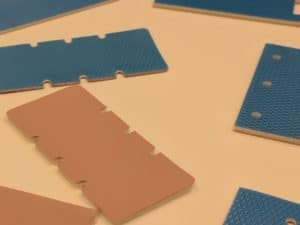
NEDC can die-cut phase-change thermal pad materials into custom shapes for production CPU cooling applications. The die-cutting process for phase-change materials is similar to traditional thermal pads, though the softer, temperature-sensitive nature of the material requires careful handling.
For more on our die-cutting capabilities, see our guide on die-cutting thermal pads.
Thermal Putty vs Thermal Pads
Thermal putty is another alternative that sits between paste and pads. It is a moldable compound applied by hand, pressed into shape between the CPU and heatsink. Unlike pads, it has no fixed shape — formed during installation.
Thermal putty advantages:
- Fills any gap size
- No thickness selection needed
- Conforms to any surface
Thermal putty disadvantages:
- Messy installation
- No consistent thickness — too much putty adds thermal resistance
- Not suitable for production (manual application only)
- Cannot be die-cut
Search volume for “thermal putty vs thermal pads” is approximately 880 monthly searches. For most production applications, phase-change pads or traditional thermal pads are a better choice than putty. For more on material types, see our guide on different types of thermal pads.
Phase-Change vs Graphene Thermal Pads
Graphene thermal pads are an emerging technology. Graphene offers extremely high in-plane thermal conductivity (up to 5,000 W/mK), but through-thickness conductivity — the direction that matters for CPU cooling — is much lower (typically 5-10 W/mK, comparable to phase-change pads).
Search volume for “graphene thermal pads” is approximately 480 monthly searches. While graphene pads show promise, they are currently more expensive and less proven in production than phase-change alternatives. For more on conductivity comparisons, see our guide on thermal conductivity is not everything.
When to Choose Phase-Change Pads for CPU Cooling
Phase-change thermal pads are the best choice when:
- Paste-level performance is needed with pad-level installation — production lines, field repair
- The CPU-to-heatsink gap is under 0.3 mm — phase-change pads are thin by design
- Consistency is critical — no skill-dependent paste application
- The CPU has an IHS or bare die with minimal gap — laptop CPUs, server CPUs with direct-die contact
Phase-change pads are not ideal when:
- The gap exceeds 0.5 mm — use a traditional gap filler pad instead
- Electrical isolation is not needed — paste may be simpler
- The application requires a thick pad for mechanical reasons
For more on phase-change materials, see our guide on phase-change thermal materials and our silicone-free gap pad options.
Sourcing Phase-Change Thermal Pads
NEDC supplies and die-cuts phase-change thermal pad materials for CPU cooling applications. For custom-cut phase-change pads, request a quote or visit our thermal pads page.