
CPU thermal pads are an alternative to thermal paste for transferring heat from a processor to its cooler. While thermal paste remains common in consumer builds, thermal pads offer advantages in production environments, field repair scenarios, and applications where consistency and ease of installation matter more than marginal thermal optimization.

This guide covers the key information for selecting CPU thermal pads — material types, conductivity, thickness, and when a pad is the right choice.
Types of CPU Thermal Pads
Sil-Pads (Silicone-Based Insulator Pads)
Sil-Pads are thin thermal pads reinforced with fiberglass or polyimide film. They provide both thermal conductivity and electrical isolation, making them suitable for CPUs where the heatsink must not make electrical contact with the processor package. NEDC stocks a range of Sil-Pads from Parker Chomerics (CHO-THERM series) and other manufacturers.
See our guide on Sil-Pad or Gap Pad for when to choose a Sil-Pad vs a gap filler pad.
Gap Filler Pads
Gap filler pads are soft, conformable pads designed to fill larger gaps between the CPU and heatsink. They are typically used in applications where the CPU and heatsink surfaces are not perfectly flat or where there is a deliberate gap for mechanical reasons. Materials like Bergquist Gap Pad 5000S35 and Laird TFLEX series are common choices.
Phase-Change Thermal Pads
Phase-change pads are a newer category that combines the ease of installation of a pad with the thermal performance of paste. These pads soften and flow at operating temperature, filling microscopic surface irregularities like paste does, but solidify when cooled. Honeywell PTM7950 is the best-known example. See our dedicated guide on phase-change thermal pads for CPU cooling for a deep dive.
Graphite and Graphene Pads
Graphite thermal pads use flexible graphite sheets as the thermal interface material. They offer high in-plane conductivity but lower through-thickness conductivity than silicone pads. Graphene pads are an emerging technology with high theoretical conductivity but limited commercial availability at production scale.
Thermal Conductivity for CPU Thermal Pads
CPU thermal pads span a wide conductivity range:
- 1.5-3 W/mK: Entry-level Sil-Pads, suitable for low-power CPUs
- 3-6 W/mK: Mid-range pads, good for most desktop CPUs
- 6-10 W/mK: High-performance pads for workstation and server CPUs
- 10+ W/mK: Ultra-high conductivity for AI accelerators and high-TDP processors
As we discuss in thermal conductivity is not everything, a pad’s actual performance depends on more than just the W/mK number. Conformability, thickness, and surface contact quality all affect real-world thermal resistance.
CPU Thermal Pad Thickness
Most CPU thermal pads are thin — typically 0.25 mm to 1.0 mm — because the CPU die and heatsink are designed to be in close contact. Gap filler pads for CPUs can be thicker (1.0-2.0 mm) when there is a deliberate gap to fill.
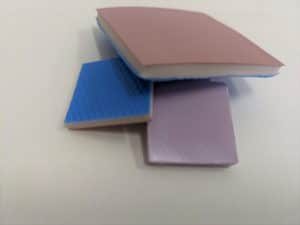
For help selecting the right thickness, see our guide on finding the perfect fit.
When to Use a Thermal Pad Instead of Thermal Paste on a CPU
Thermal pads excel in several scenarios where thermal paste is less practical:
- Production assembly — pads are faster to install, require no curing time, and eliminate the risk of applying too much or too little paste
- Field repair — a pre-cut pad is easier to apply than paste in the field, especially in constrained environments
- Electrical isolation required — if the heatsink must be electrically isolated from the CPU, a Sil-Pad provides both thermal transfer and isolation
- Consistent installation — pads provide the same thermal interface every time, without the variability of manual paste application
For a detailed comparison, see our guide on thermal pad vs thermal paste for CPU and the existing overview on using thermal pads for CPUs.
Sourcing CPU Thermal Pads
NEDC die-cuts CPU thermal pads from materials by Bergquist, Laird, Parker Chomerics, T-Global, and FujiPoly. We can produce custom shapes and thicknesses for production runs, prototypes, and replacement applications.
For production CPU cooling applications, see our companion guide on best CPU thermal pads for industrial applications.
Request a quote with specifications, or visit our thermal pads page for the full material catalog.